Mar 26, 2026
Week 23 – Material Selection and Grounded Detailing
Refining the project through material realism, where specification, planting and construction detail begin to stabilise the design.
Technical
Flow
Selecting a material that balances structure, durability and performance.
A key discussion with Peter centred on the material choice for the boardwalk surface. He strongly advised against both timber and in-situ concrete for the deck. Timber introduces long-term maintenance challenges, particularly in exposed and wet environments, while concrete significantly increases structural load, requiring more frequent supports and more complex detailing.
Instead, he recommended an aluminium decking system, specifically the Neaco 188Dek gap-free aluminium decking. This system offers a lightweight alternative with high durability, non-combustibility and integrated drainage through concealed joints. Its modular nature allows for efficient installation and consistent performance across large spans. The possibility of a coloured finish, such as an orange coating, supports the visual identity of the project while maintaining technical reliability. This decision aligns the boardwalk with a more feasible structural logic, reducing load while maintaining a robust walking surface.

Planting
Expanding the ornamental palette to support structure, scale and seasonal change.
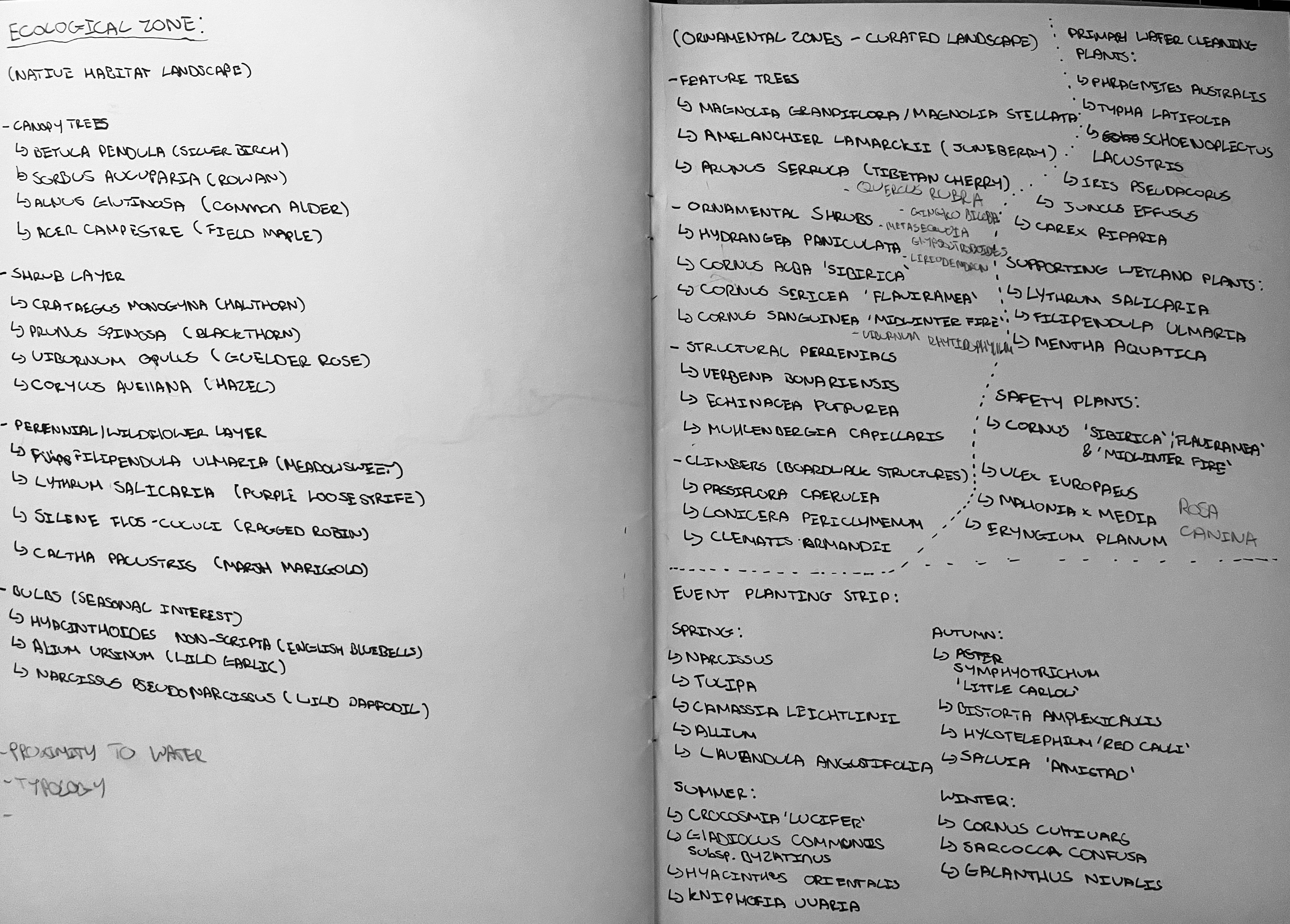
We reviewed and expanded the planting palette, particularly within the ornamental zones. Peter introduced a series of species that strengthen both vertical structure and seasonal variation. Trees such as Liriodendron tulipifera, Metasequoia glyptostroboides, Ginkgo biloba, Quercus rubra and Quercus ellipsoidalis provide height, canopy presence and long-term spatial definition. These are complemented by shrubs and herbaceous planting including Viburnum rhytidophyllum, Prunus spinosa, Hippophae rhamnoides and Berberis, which contribute to density, habitat value and defensive planting where needed.
Grasses such as Miscanthus sinensis and Pennisetum rubrum introduce movement, texture and seasonal dynamism, particularly in transitional zones between formal and ecological planting. This expanded palette strengthens the legibility of different zones while ensuring that planting is not only aesthetic but also spatially and ecologically performative.
Construction
Resolving ground interfaces through realistic build-ups and structural support.
The discussion also moved into detailed construction logic, particularly around gabions, pathways and ecological strips. For gabion structures, Peter emphasised the use of gabion facing stones on visible surfaces, with less refined material used internally. This ensures visual quality without unnecessary material cost. He also noted the importance of adequate footing depth, as gabions require stable foundations to resist settlement and lateral movement, particularly where they retain soil or sit adjacent to water.
For stepping stone pathways, he advised that these must sit on a prepared base, either compacted subgrade or a concrete footing, to prevent movement and ensure long-term stability. This reinforces that even informal elements require proper construction detailing.
Finally, the ecological strip between kerbs was discussed in relation to water management. Setting this strip lower than surrounding surfaces allows it to function as a linear attenuation feature, capturing and temporarily storing runoff before it infiltrates or is conveyed onward. This integrates drainage directly into the landscape section, ensuring that water management is embedded within the spatial design rather than treated as a separate system.
Reflection
This week brought a strong sense of material and technical grounding to the project. Decisions are becoming less speculative and more rooted in buildability and performance. The shift toward aluminium decking, expanded planting structure and realistic construction detailing reinforces the project’s feasibility. The design is now being defined not just by its form, but by how convincingly it can be constructed and maintained over time.
