Sep 25, 2025
Week 1 - Among the Trees
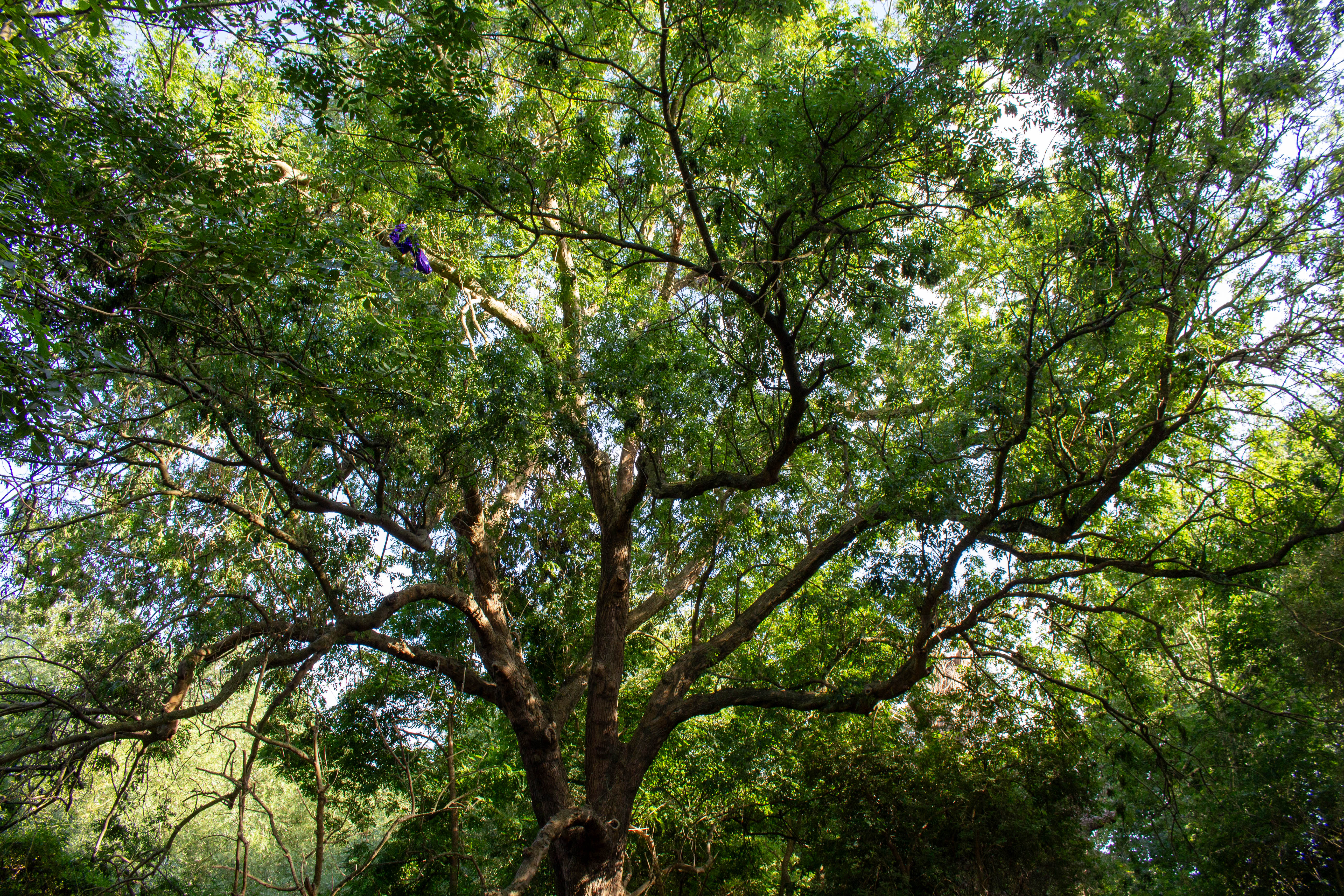
Where roots occupy engineered ground, canopies modify climate and policy governs intervention, arboriculture operates between biology, risk and design.
Technical
Flow
Understanding trees as integrated biological systems of uptake, transport and structural stability.
This week introduced arboriculture as the management and study of trees within constructed environments, where biological processes must be understood in relation to soil behaviour, loading and development pressure. Trees operate as integrated systems where failure in one component can affect overall health, stability and lifespan.
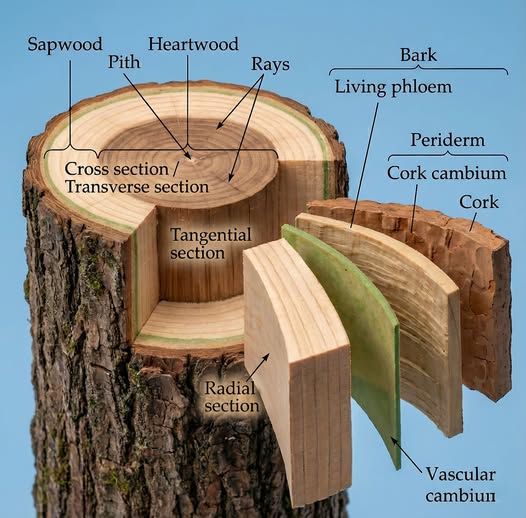
Roots function both structurally and physiologically. They anchor the tree while absorbing water and nutrients, primarily within the upper 300–600 mm of soil, where oxygen availability supports fine root growth. Root hairs increase absorptive capacity while mycorrhizal fungi extend the effective root network, forming symbiotic relationships that improve nutrient exchange and resilience. Above ground, xylem transports water and dissolved minerals upward through transpiration-driven flow, while phloem distributes sugars and hormones to areas of growth and storage. The cambium generates new vascular tissue, enabling radial growth and structural reinforcement. Even heartwood, though no longer biologically active, provides essential compressive strength.
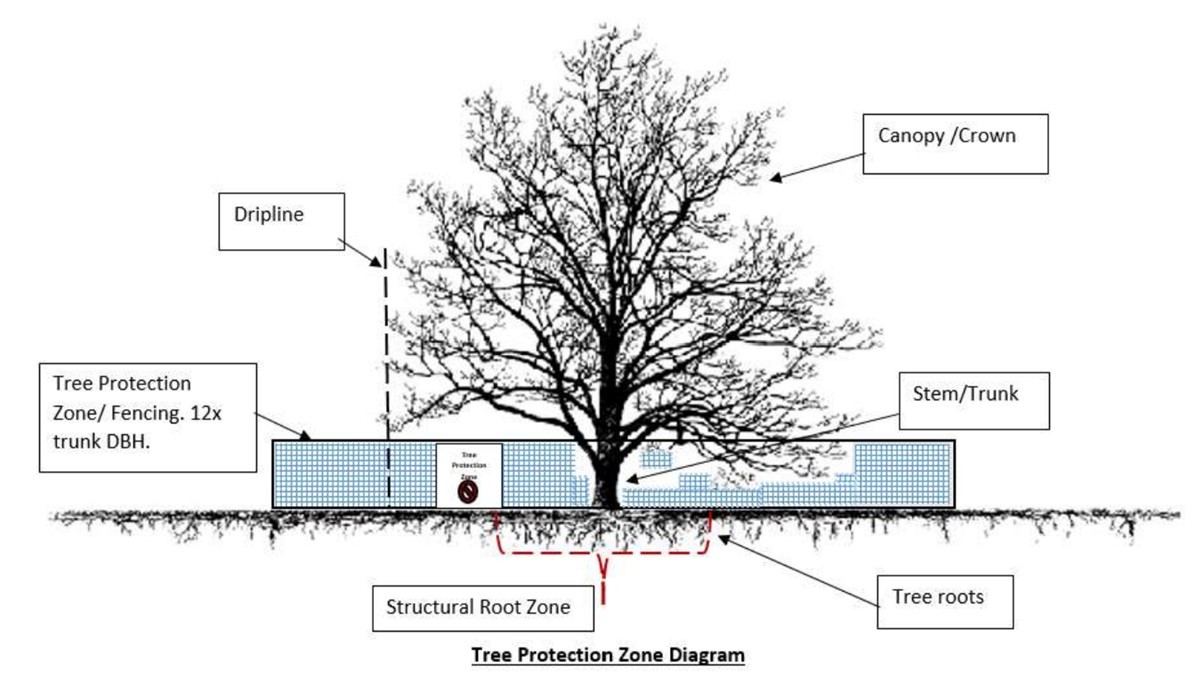
We discussed the Root Protection Area (RPA) as defined in BS 5837:2012, calculated as a radius of 12 times the stem diameter at 1.5 m height (DBH). This is not an exact representation of root spread but a precautionary design tool used to prevent soil compaction, excavation damage and hydrological change within the root zone. Disturbance within this area can reduce oxygen availability, damage fine roots and destabilise the tree. The RPA therefore acts as a fixed constraint in design, forcing spatial decisions to respond to existing biological systems.
Stewardship
Arboriculture as a regulated practice balancing tree biology, risk management and development pressure.
The session emphasised that arboriculture operates within a complex human and regulatory context. Arboriculturists must translate biological understanding into clear, defensible recommendations for planners, designers, contractors and the public. We discussed statutory protections such as Tree Preservation Orders and the need for arboricultural reports to remain accurate, proportionate and confined to professional competence.
Central to this discussion was the Root Protection Area (RPA), a key design and planning tool developed by Dr Giles Biddle and formalised in British Standards. The RPA is calculated as a circle with a radius twelve times the tree’s stem diameter measured at 1.5 metres above ground level, representing the minimum area required to protect the majority of a tree’s rooting environment. Research shows that most fine roots responsible for water and nutrient uptake are located within the upper 600 mm of soil, making them highly vulnerable to compaction, excavation and changes in soil moisture.
Damage within the RPA, whether through heavy machinery, material storage or changes in ground levels, can lead to reduced oxygen availability, root death and long-term decline. The RPA therefore acts as a spatial constraint on design, influencing building footprints, service routes and hard landscape proposals. Arboriculture was framed here as a form of preventative engineering, where protecting soil structure and porosity is as critical as protecting the tree itself.
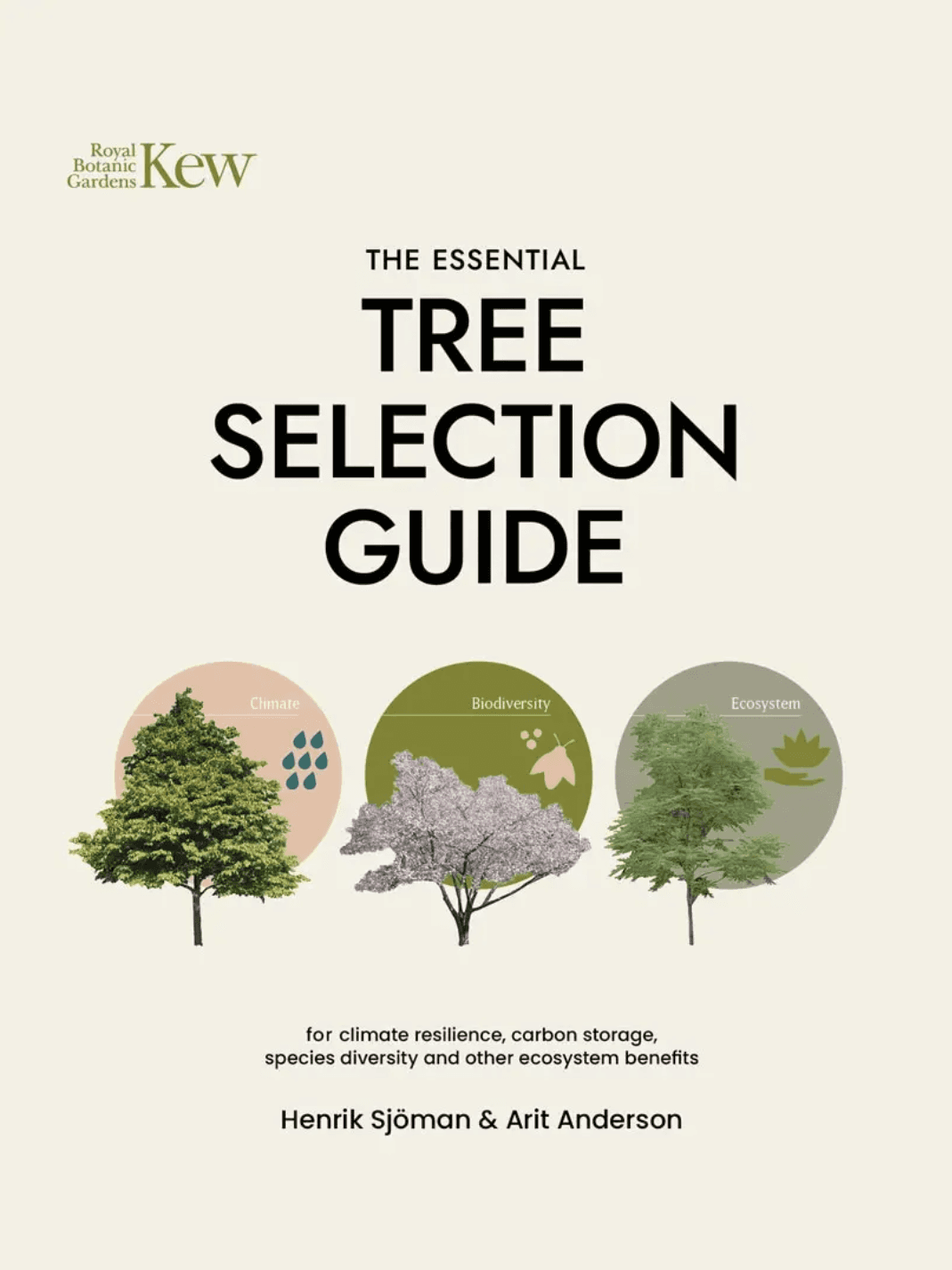
Tree selection was discussed using the Kew Gardens Tree Selection Guide, which prioritises ecological suitability over visual preference. Species choice must account for mature size, rooting behaviour, tolerance of compaction, waterlogging or drought, and potential conflicts with surrounding infrastructure. Shade and shadow analysis at midsummer was highlighted as a technical tool, as canopy form directly affects thermal comfort, daylight access and microclimatic conditions within public spaces.
Ecology
Woodlands as layered ecological systems shaped by time, continuity and intervention.
The latter part of the session focused on woodland ecology, examining how groups of trees form vertically stratified systems that regulate light, moisture and temperature. A woodland is defined not simply by tree presence but by canopy density sufficient to influence conditions beneath, creating distinct layers: canopy, understory, field layer and ground layer. These layers interact to produce microclimates that support diverse plant, fungal and animal communities.
We examined ancient woodlands, defined in England as sites that have existed continuously since at least 1600 AD. Their value lies in ecological continuity rather than age alone. Undisturbed soils, long-established mycorrhizal networks and slow colonising plant species create systems that cannot be recreated within typical project timescales. Białowieża National Park was used as a case study of a primeval forest, illustrating both ecological complexity and the vulnerability of such systems to logging and political intervention.
Woodlands were framed as multifunctional landscapes providing carbon sequestration, air filtration, soil stabilisation and habitat, while also supporting timber production, education and recreation. From a landscape architecture perspective, intervention requires restraint. Effective woodland management involves surveying existing conditions, retaining deadwood, encouraging natural regeneration and designing access routes that minimise compaction and fragmentation. Practices such as coppicing, thinning and successional planting were discussed as adaptive management tools that maintain structural diversity and long-term resilience.
Reflection:
This session established trees and woodlands as technically complex living systems whose success within landscapes depends on informed stewardship rather than aesthetic control. Understanding arboriculture in terms of soil protection, physiological process and regulatory constraint highlighted how early design decisions directly influence long-term ecological health. For landscape practice, the lesson reinforced that protecting living systems below ground is foundational to any meaningful intervention above.