2025
Reach Beyond Design
The project investigates how designed landscapes continually shift through ecological processes and human occupation, revealing that boundaries are temporary conditions rather than fixed design outcomes.
Ecology
Negotiation
Investigation
The project began by questioning the stability of designed landscapes and the assumption that they remain as intended.
The core investigation challenges the idea that landscapes are static compositions. Instead it examines them as living territories continually negotiated between human occupation and natural processes. The project argues that every designed landscape exists in a state of transformation, where prescribed boundaries dissolve through ecological succession, climatic processes and everyday human behaviour. Deterioration is reframed not as failure but as evidence that landscapes are never complete. They continue to evolve long after construction, shaped by forces that design cannot fully control. This position establishes the intellectual foundation of the project: landscape architecture must be understood as the design of evolving relationships rather than fixed forms.
The original investigation began through proximity. Human proximity was defined not by reach but by perception, asking what people can see, hear, smell, touch and influence. Ecological proximity emerged alongside it, measuring ecological influence through falling leaves, spreading roots, escaping seeds, blown sand, flowing water and creeping vines. These territories rarely stopped at designed edges. They leaked, drifted and accumulated, revealing that the landscape did not behave according to its original design. As mapping continued, proximity shifted into exchange. The circles used to measure influence began revealing boundaries breaking down. Grass grew into sand, sand moved across timber, vines climbed structures, leaves covered hardscape and mud dissolved edges. These were not isolated observations but evidence of territorial negotiation.

Actors
The project identifies two systems continually reshaping the landscape through occupation and adaptation.
Human systems include architecture, paths, retaining walls, decks, sand pits, recreational equipment, maintenance, litter, footprints, desire paths, trampling and displaced materials. Humans continually redefine landscapes through occupation, and even after leaving, evidence remains. Sand on timber, flattened grass, broken stems, compacted soil and wear patterns reveal residual presence. Human proximity therefore extends beyond occupation. It exists through residue.
Ecological systems possess equal agency. Nature responds, adapts and spreads. Grass colonises open ground, seeds disperse, leaves accumulate, mud migrates, water reshapes surfaces, vines search for support and roots undermine construction. Decay weakens materials. Ecology actively negotiates space. The project therefore investigates the space between these opposing forces. Human design attempts to establish permanence. Nature continuously produces change. The conflict is not destructive but persistent, revealing landscapes as dynamic territories shaped by continual exchange.
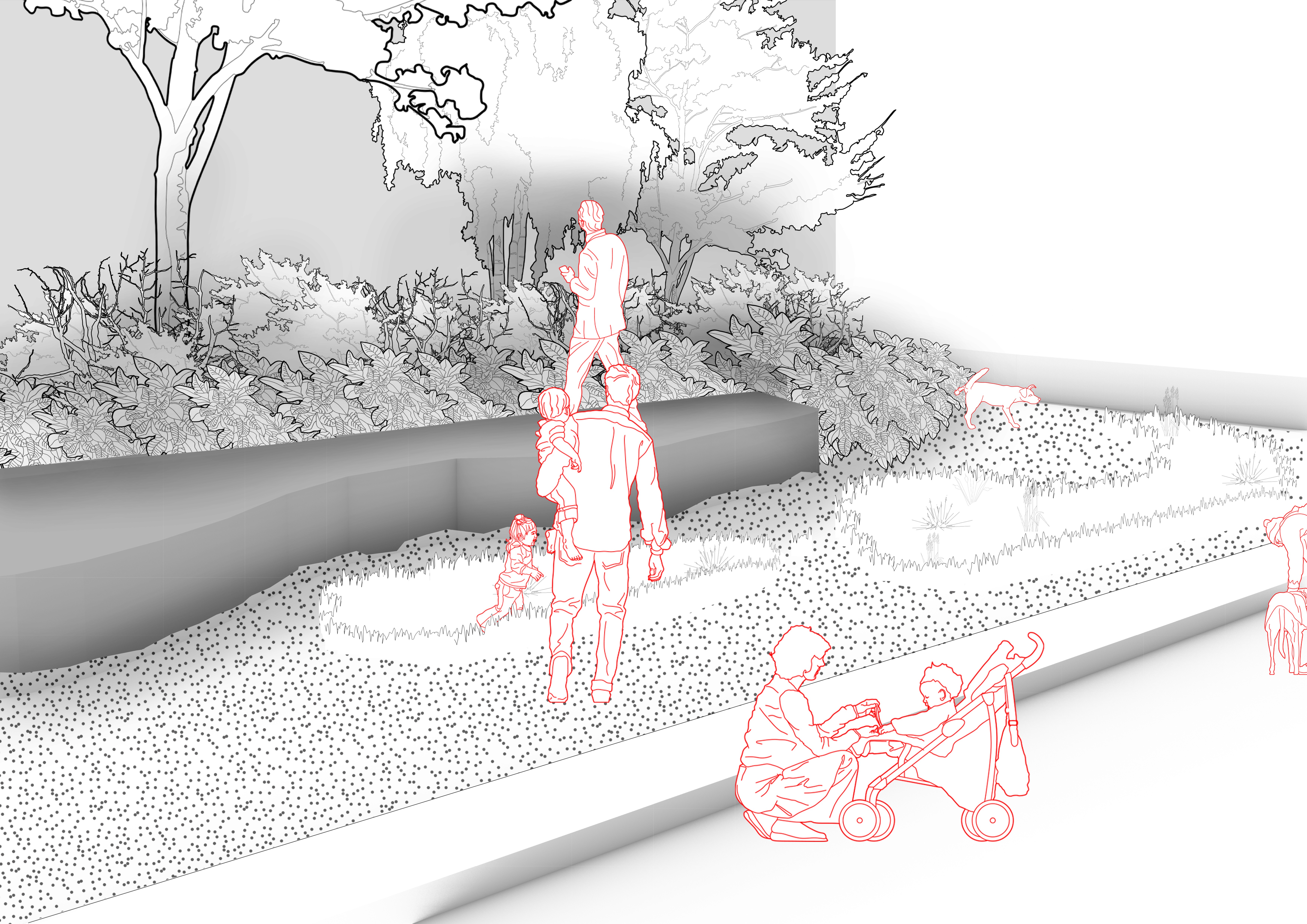
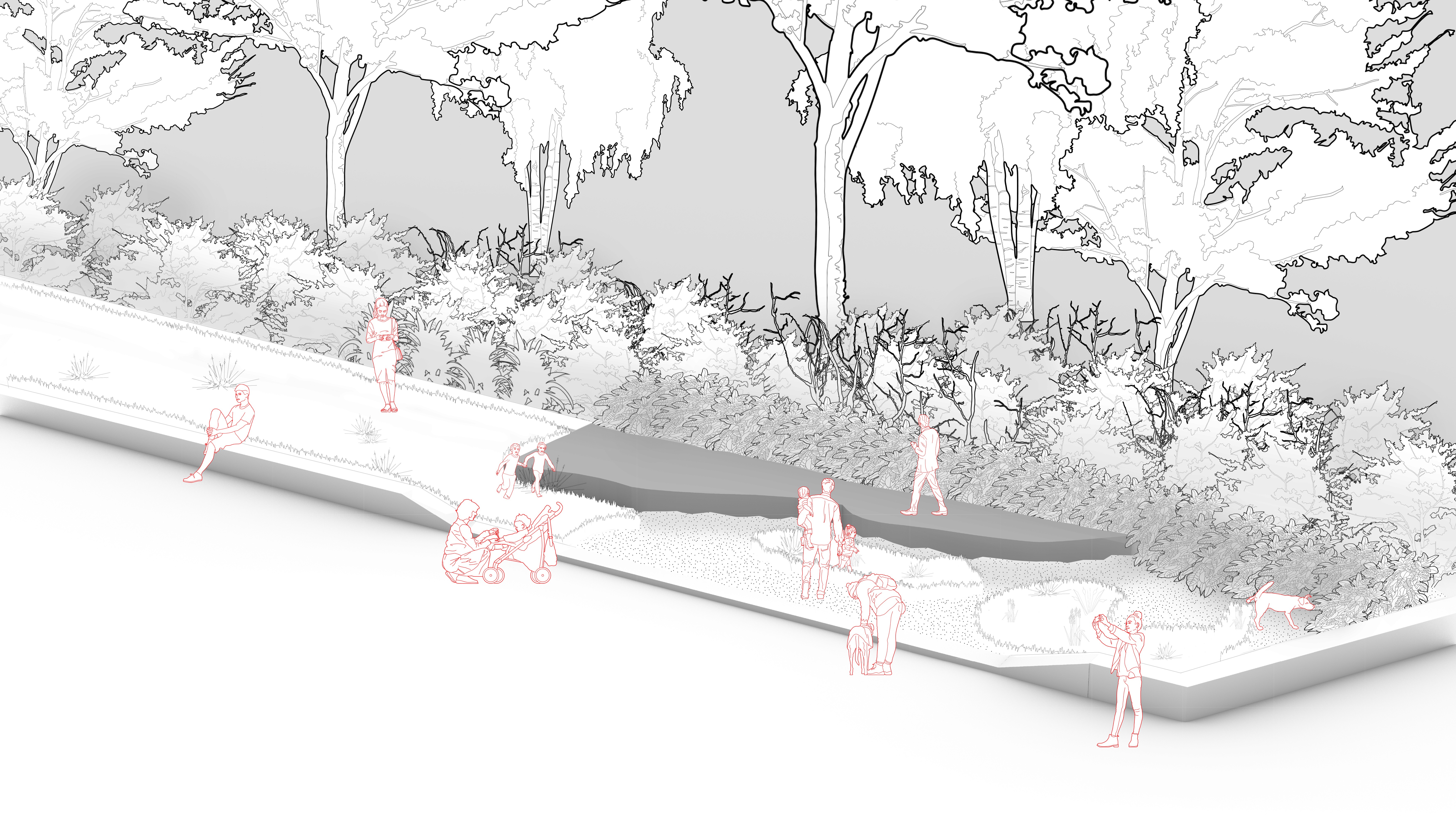
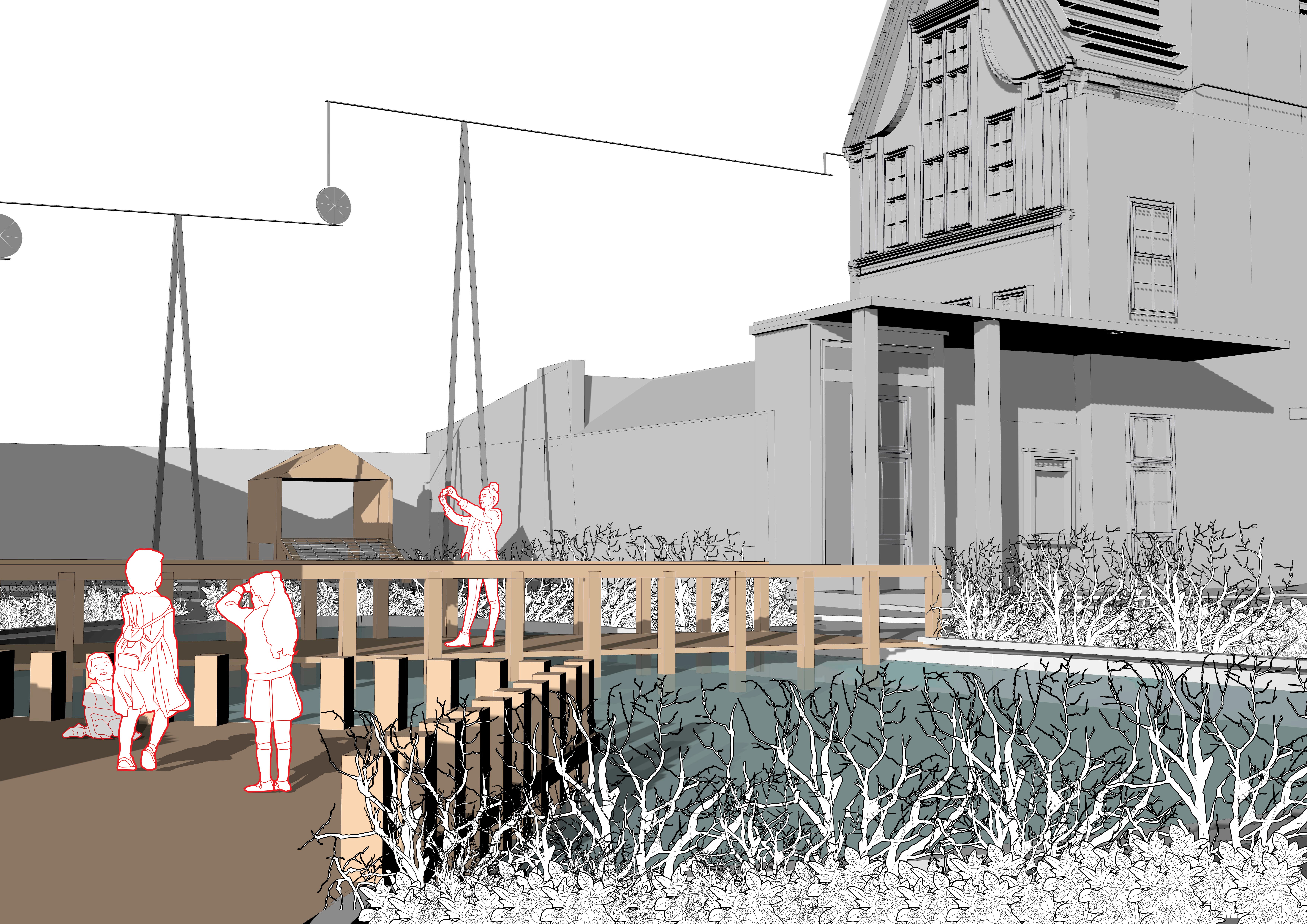
The Linear Park becomes the perfect laboratory. Originally divided into prescribed recreational zones of grass, sand, deck and planting, each with a specific purpose and physical separation, the site slowly dissolves these distinctions. The deck becomes sandy, the sand becomes grassy, vines occupy timber, leaves occupy recreation and mud occupies circulation. Every surface begins borrowing characteristics from another. These overlaps reveal transitional ecologies that are neither human nor natural but negotiated.


Process
Mapping and material investigation reveal how boundaries dissolve through continual movement and ecological succession.
Traditional site plans record permanence. The project’s maps instead record process. Each drawing becomes a snapshot within an ongoing ecological timeline. Nothing is final. Every map becomes evidence of what is becoming rather than what exists. The project isolates three materials as indicators of ecological negotiation.
Vines represent vertical occupation. They search, climb, wrap, suspend and anchor, slowly occupying built structures never intended for vegetation. They transform architecture into ecology. Grass represents colonisation. It expands continuously, exploiting disturbed ground, loose substrate, moisture and neglected edges. Its growth documents where ecological succession begins reclaiming recreational territory. Sand becomes the most unstable material. It possesses no fixed boundary and is transported by wind, rain, footsteps, children, maintenance, animals and gravity. Sand records movement. It cannot grow but migrates, becoming physical evidence of occupation.
Catalysts accelerate transformation. Sunlight drives photosynthesis, shapes growth direction and influences seasonal expansion. Rain redistributes soil, carries mud, encourages germination and weakens constructed edges. Wind disperses seeds, carries leaves, moves sand and deposits debris. Human occupation creates desire paths, redistributes sand, breaks vegetation, compacts soil and introduces foreign materials. These catalysts reveal that landscapes are shaped by forces that continually redraw boundaries.

Position
The project reframes landscape architecture as the design of evolving relationships rather than fixed forms.
The most significant discovery is overlap. Grass within sand, sand across timber, vines across deck, mud over paving and leaves inside recreation reveal transitional ecologies where territories merge. These moments show that boundaries are fictional. The line between human and ecological territory exists only in drawings. On site, every boundary is temporary. Nature negotiates it. Humans renegotiate it. The landscape exists as a perpetual exchange of materials, movement, occupation, decay, growth and adaptation.
The design response accepts instability rather than restoring rigid order. The intervention works with ecological behaviour instead of suppressing it. Rain gardens celebrate water movement. Planting embraces succession. Spaces allow controlled ecological expansion. Materials weather naturally. Boundaries become gradients rather than hard edges. This position argues that nature should not simply be accommodated. It should be understood as an active design participant. Design becomes an evolving conversation rather than a finished object.
This project investigates the continuous negotiation between human intention and ecological agency, revealing how designed boundaries dissolve through the persistent exchange of growth, movement, occupation and decay. It moves beyond documenting overgrown spaces and instead argues that landscapes are defined not by the boundaries we design but by the continual processes that erase and redraw them. This reframes landscape architecture as the design of evolving relationships, allowing the project to stand as a more original and intellectually coherent exploration of dynamic territorial coexistence.
More Works
(TEB® — 02)
©2026
More Works
©2026


2025
Reach Beyond Design
The project investigates how designed landscapes continually shift through ecological processes and human occupation, revealing that boundaries are temporary conditions rather than fixed design outcomes.
Ecology
Negotiation
Investigation
The project began by questioning the stability of designed landscapes and the assumption that they remain as intended.
The core investigation challenges the idea that landscapes are static compositions. Instead it examines them as living territories continually negotiated between human occupation and natural processes. The project argues that every designed landscape exists in a state of transformation, where prescribed boundaries dissolve through ecological succession, climatic processes and everyday human behaviour. Deterioration is reframed not as failure but as evidence that landscapes are never complete. They continue to evolve long after construction, shaped by forces that design cannot fully control. This position establishes the intellectual foundation of the project: landscape architecture must be understood as the design of evolving relationships rather than fixed forms.
The original investigation began through proximity. Human proximity was defined not by reach but by perception, asking what people can see, hear, smell, touch and influence. Ecological proximity emerged alongside it, measuring ecological influence through falling leaves, spreading roots, escaping seeds, blown sand, flowing water and creeping vines. These territories rarely stopped at designed edges. They leaked, drifted and accumulated, revealing that the landscape did not behave according to its original design. As mapping continued, proximity shifted into exchange. The circles used to measure influence began revealing boundaries breaking down. Grass grew into sand, sand moved across timber, vines climbed structures, leaves covered hardscape and mud dissolved edges. These were not isolated observations but evidence of territorial negotiation.
Actors
The project identifies two systems continually reshaping the landscape through occupation and adaptation.
Human systems include architecture, paths, retaining walls, decks, sand pits, recreational equipment, maintenance, litter, footprints, desire paths, trampling and displaced materials. Humans continually redefine landscapes through occupation, and even after leaving, evidence remains. Sand on timber, flattened grass, broken stems, compacted soil and wear patterns reveal residual presence. Human proximity therefore extends beyond occupation. It exists through residue.
Ecological systems possess equal agency. Nature responds, adapts and spreads. Grass colonises open ground, seeds disperse, leaves accumulate, mud migrates, water reshapes surfaces, vines search for support and roots undermine construction. Decay weakens materials. Ecology actively negotiates space. The project therefore investigates the space between these opposing forces. Human design attempts to establish permanence. Nature continuously produces change. The conflict is not destructive but persistent, revealing landscapes as dynamic territories shaped by continual exchange.
The Linear Park becomes the perfect laboratory. Originally divided into prescribed recreational zones of grass, sand, deck and planting, each with a specific purpose and physical separation, the site slowly dissolves these distinctions. The deck becomes sandy, the sand becomes grassy, vines occupy timber, leaves occupy recreation and mud occupies circulation. Every surface begins borrowing characteristics from another. These overlaps reveal transitional ecologies that are neither human nor natural but negotiated.
Process
Mapping and material investigation reveal how boundaries dissolve through continual movement and ecological succession.
Traditional site plans record permanence. The project’s maps instead record process. Each drawing becomes a snapshot within an ongoing ecological timeline. Nothing is final. Every map becomes evidence of what is becoming rather than what exists. The project isolates three materials as indicators of ecological negotiation.
Vines represent vertical occupation. They search, climb, wrap, suspend and anchor, slowly occupying built structures never intended for vegetation. They transform architecture into ecology. Grass represents colonisation. It expands continuously, exploiting disturbed ground, loose substrate, moisture and neglected edges. Its growth documents where ecological succession begins reclaiming recreational territory. Sand becomes the most unstable material. It possesses no fixed boundary and is transported by wind, rain, footsteps, children, maintenance, animals and gravity. Sand records movement. It cannot grow but migrates, becoming physical evidence of occupation.
Catalysts accelerate transformation. Sunlight drives photosynthesis, shapes growth direction and influences seasonal expansion. Rain redistributes soil, carries mud, encourages germination and weakens constructed edges. Wind disperses seeds, carries leaves, moves sand and deposits debris. Human occupation creates desire paths, redistributes sand, breaks vegetation, compacts soil and introduces foreign materials. These catalysts reveal that landscapes are shaped by forces that continually redraw boundaries.
Position
The project reframes landscape architecture as the design of evolving relationships rather than fixed forms.
The most significant discovery is overlap. Grass within sand, sand across timber, vines across deck, mud over paving and leaves inside recreation reveal transitional ecologies where territories merge. These moments show that boundaries are fictional. The line between human and ecological territory exists only in drawings. On site, every boundary is temporary. Nature negotiates it. Humans renegotiate it. The landscape exists as a perpetual exchange of materials, movement, occupation, decay, growth and adaptation.
The design response accepts instability rather than restoring rigid order. The intervention works with ecological behaviour instead of suppressing it. Rain gardens celebrate water movement. Planting embraces succession. Spaces allow controlled ecological expansion. Materials weather naturally. Boundaries become gradients rather than hard edges. This position argues that nature should not simply be accommodated. It should be understood as an active design participant. Design becomes an evolving conversation rather than a finished object.
This project investigates the continuous negotiation between human intention and ecological agency, revealing how designed boundaries dissolve through the persistent exchange of growth, movement, occupation and decay. It moves beyond documenting overgrown spaces and instead argues that landscapes are defined not by the boundaries we design but by the continual processes that erase and redraw them. This reframes landscape architecture as the design of evolving relationships, allowing the project to stand as a more original and intellectually coherent exploration of dynamic territorial coexistence.
More Works
(TEB® — 02)
©2026
2025
Reach Beyond Design
The project investigates how designed landscapes continually shift through ecological processes and human occupation, revealing that boundaries are temporary conditions rather than fixed design outcomes.
Ecology
Negotiation
Investigation
The project began by questioning the stability of designed landscapes and the assumption that they remain as intended.
The core investigation challenges the idea that landscapes are static compositions. Instead it examines them as living territories continually negotiated between human occupation and natural processes. The project argues that every designed landscape exists in a state of transformation, where prescribed boundaries dissolve through ecological succession, climatic processes and everyday human behaviour. Deterioration is reframed not as failure but as evidence that landscapes are never complete. They continue to evolve long after construction, shaped by forces that design cannot fully control. This position establishes the intellectual foundation of the project: landscape architecture must be understood as the design of evolving relationships rather than fixed forms.
The original investigation began through proximity. Human proximity was defined not by reach but by perception, asking what people can see, hear, smell, touch and influence. Ecological proximity emerged alongside it, measuring ecological influence through falling leaves, spreading roots, escaping seeds, blown sand, flowing water and creeping vines. These territories rarely stopped at designed edges. They leaked, drifted and accumulated, revealing that the landscape did not behave according to its original design. As mapping continued, proximity shifted into exchange. The circles used to measure influence began revealing boundaries breaking down. Grass grew into sand, sand moved across timber, vines climbed structures, leaves covered hardscape and mud dissolved edges. These were not isolated observations but evidence of territorial negotiation.
Actors
The project identifies two systems continually reshaping the landscape through occupation and adaptation.
Human systems include architecture, paths, retaining walls, decks, sand pits, recreational equipment, maintenance, litter, footprints, desire paths, trampling and displaced materials. Humans continually redefine landscapes through occupation, and even after leaving, evidence remains. Sand on timber, flattened grass, broken stems, compacted soil and wear patterns reveal residual presence. Human proximity therefore extends beyond occupation. It exists through residue.
Ecological systems possess equal agency. Nature responds, adapts and spreads. Grass colonises open ground, seeds disperse, leaves accumulate, mud migrates, water reshapes surfaces, vines search for support and roots undermine construction. Decay weakens materials. Ecology actively negotiates space. The project therefore investigates the space between these opposing forces. Human design attempts to establish permanence. Nature continuously produces change. The conflict is not destructive but persistent, revealing landscapes as dynamic territories shaped by continual exchange.
The Linear Park becomes the perfect laboratory. Originally divided into prescribed recreational zones of grass, sand, deck and planting, each with a specific purpose and physical separation, the site slowly dissolves these distinctions. The deck becomes sandy, the sand becomes grassy, vines occupy timber, leaves occupy recreation and mud occupies circulation. Every surface begins borrowing characteristics from another. These overlaps reveal transitional ecologies that are neither human nor natural but negotiated.
Process
Mapping and material investigation reveal how boundaries dissolve through continual movement and ecological succession.
Traditional site plans record permanence. The project’s maps instead record process. Each drawing becomes a snapshot within an ongoing ecological timeline. Nothing is final. Every map becomes evidence of what is becoming rather than what exists. The project isolates three materials as indicators of ecological negotiation.
Vines represent vertical occupation. They search, climb, wrap, suspend and anchor, slowly occupying built structures never intended for vegetation. They transform architecture into ecology. Grass represents colonisation. It expands continuously, exploiting disturbed ground, loose substrate, moisture and neglected edges. Its growth documents where ecological succession begins reclaiming recreational territory. Sand becomes the most unstable material. It possesses no fixed boundary and is transported by wind, rain, footsteps, children, maintenance, animals and gravity. Sand records movement. It cannot grow but migrates, becoming physical evidence of occupation.
Catalysts accelerate transformation. Sunlight drives photosynthesis, shapes growth direction and influences seasonal expansion. Rain redistributes soil, carries mud, encourages germination and weakens constructed edges. Wind disperses seeds, carries leaves, moves sand and deposits debris. Human occupation creates desire paths, redistributes sand, breaks vegetation, compacts soil and introduces foreign materials. These catalysts reveal that landscapes are shaped by forces that continually redraw boundaries.
Position
The project reframes landscape architecture as the design of evolving relationships rather than fixed forms.
The most significant discovery is overlap. Grass within sand, sand across timber, vines across deck, mud over paving and leaves inside recreation reveal transitional ecologies where territories merge. These moments show that boundaries are fictional. The line between human and ecological territory exists only in drawings. On site, every boundary is temporary. Nature negotiates it. Humans renegotiate it. The landscape exists as a perpetual exchange of materials, movement, occupation, decay, growth and adaptation.
The design response accepts instability rather than restoring rigid order. The intervention works with ecological behaviour instead of suppressing it. Rain gardens celebrate water movement. Planting embraces succession. Spaces allow controlled ecological expansion. Materials weather naturally. Boundaries become gradients rather than hard edges. This position argues that nature should not simply be accommodated. It should be understood as an active design participant. Design becomes an evolving conversation rather than a finished object.
This project investigates the continuous negotiation between human intention and ecological agency, revealing how designed boundaries dissolve through the persistent exchange of growth, movement, occupation and decay. It moves beyond documenting overgrown spaces and instead argues that landscapes are defined not by the boundaries we design but by the continual processes that erase and redraw them. This reframes landscape architecture as the design of evolving relationships, allowing the project to stand as a more original and intellectually coherent exploration of dynamic territorial coexistence.
More Works
©2026