Jan 27, 2026
Week 3 – Making the Narrative Visible
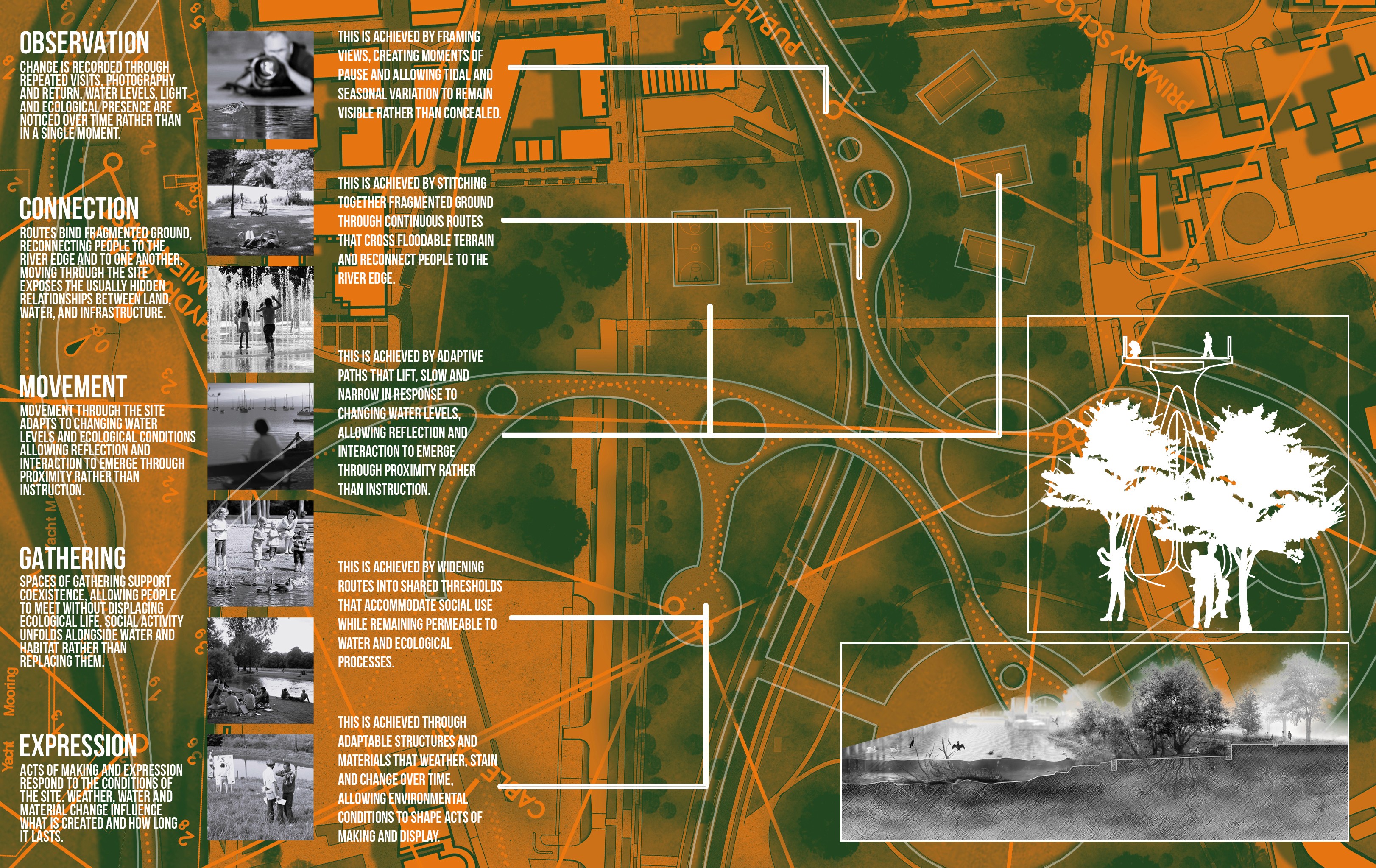
A week spent realising that narrative does not exist in words alone, but must be made spatially and visually legible through drawing.
Resolution
Translation
Learning that labels are not the same as communication.
This week I focused more on my narrative poster than on the 1:1000 drawing. The main feedback made it clear that my work was still relying too heavily on written labels rather than visual explanation. I was told I need to visualise the wording, allowing movement, connection, gathering and observation to be read directly through the drawing itself. This highlighted a gap between intention and representation. I understood what the project was doing, but I had not yet made that logic visible to someone else without explanation.
Layers
Bringing the past and present into the same spatial conversation.
A key suggestion was to show both old and new movement systems, and to clearly mark where they overlap, diverge or intersect. This reframed movement as something layered rather than replaced. Similarly, I was encouraged to bring older site layers into a more prominent analytical position, allowing the proposal to be understood as a continuation or transformation rather than a clean insertion. The boardwalk itself also needed clearer emphasis against the background so that the proposal could be distinguished more confidently from existing conditions.
Specificity
Showing where things happen, not just that they happen.
For themes such as connection, gathering, expression and observation, the feedback was consistent: I need to point to the exact places where these occur. Connection should be shown across layers, not just described. Gathering and expression need identifiable spatial moments. Observation requires both the spaces being looked at and the places from which they are observed. This shifted my understanding of narrative from abstract qualities to spatially located events.
Reflection
This week made it clear that narrative in design must be drawn, not just written. The feedback did not ask for more ideas, but for greater precision in how those ideas are shown. I left the session understanding that resolution in this module is about making relationships, overlaps and events visible, so the drawing itself can carry the story without relying on explanation.